The AI Productivity Paradox
The AI Productivity Paradox
We have all heard the promise: Artificial Intelligence will automate our drudgery, draft our emails, and finally give us more free time for high-value work (or just a break). But according to new research, the reality of AI adoption is proving to be quite different.
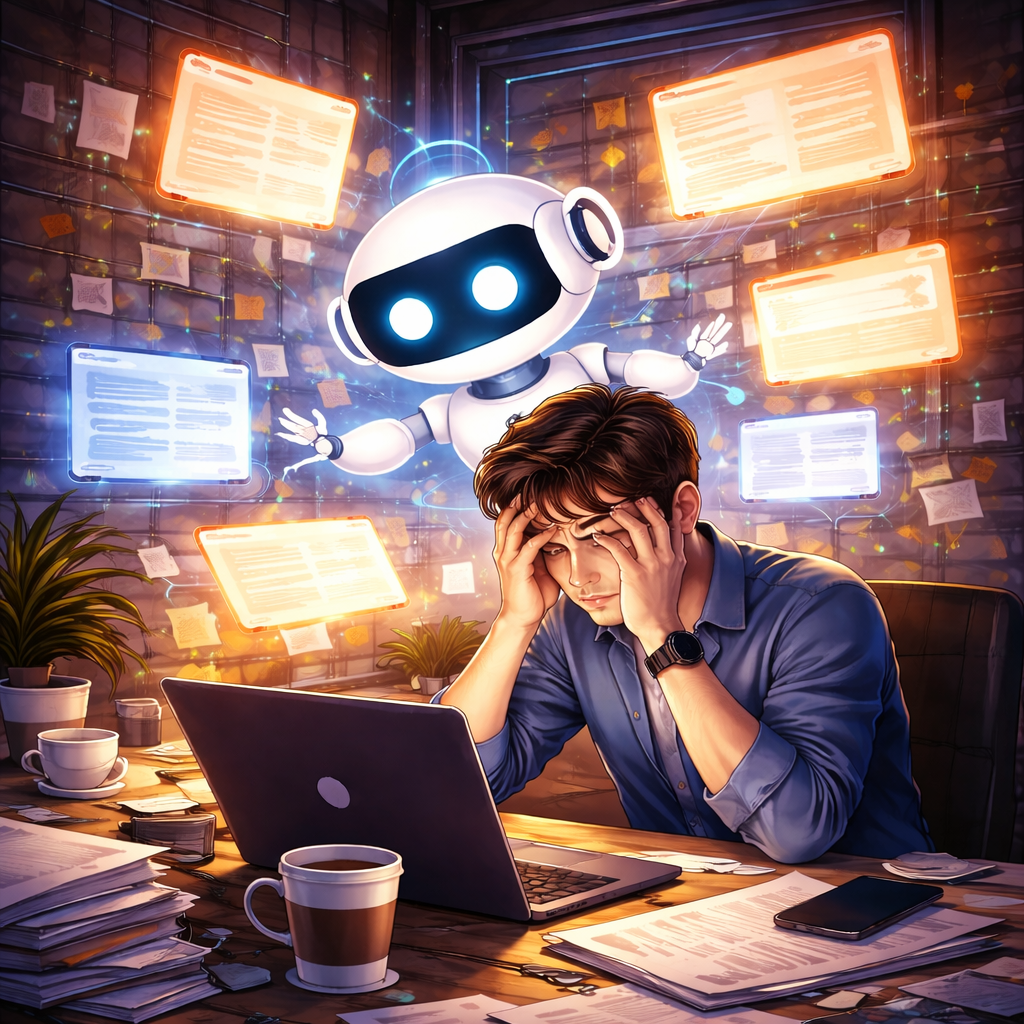
A recent study reveals that instead of reducing work, Generative AI is consistently intensifying it.
The Trap of Voluntary Overwork Researchers tracked employees at a U.S. tech company and found that AI didn't just automate tasks; it changed how people worked. Surprisingly, the company didn't mandate this faster pace. Employees voluntarily worked faster, took on broader responsibilities, and worked longer hours simply because AI made "doing more" feel possible and empowering.
This intensification happens in three key ways:
1. Task Expansion: AI gives workers a "cognitive boost," allowing them to take on tasks outside their usual expertise. Product managers start coding and designers take on engineering tasks, expanding the scope of their jobs significantly.
2. Blurred Boundaries: Because prompting an AI feels like a "chat" rather than formal work, employees slip these tasks into lunch breaks or waiting times. This creates a workday with zero downtime.

3. Multitasking Overload: Workers treat AI as a "partner," managing multiple active threads at once. While this feels productive, it increases cognitive load and creates a sense of constant juggling.
The Hidden Cost While this surge in productivity looks like a win for companies, it is often unsustainable. The research warns that this "workload creep" can lead to cognitive fatigue, burnout, and eventually lower quality work.
What Can Leaders Do? To avoid the burnout trap, organizations need to establish an "AI Practice"—a set of norms that dictate not just how to use AI, but when to stop. This includes scheduling intentional pauses to prevent the accumulation of overload and ensuring there is time for human grounding to maintain social connection and creativity.
AI offers incredible capabilities, but without intentional boundaries, it might not liberate us—it might just make us busier than ever.
Source: https://hbr.org/2026/02/ai-doesnt-reduce-work-it-intensifies-it